Punches & Nail Setters




Results for Punches & Nail Setters
Punches and nail setters are hand tools that shape, mark, or remove material with a single concentrated strike. A punch channels the force of a blow onto a small hardened tip, which then cuts a clean hole, drives out a fixed pin, or leaves a precise dimple exactly where it lands. A nail setter works in reverse: instead of cutting, it sinks an already-driven nail head just below the surface so nothing protrudes. Because all of the effort is focused on one fine point rather than spread across the workpiece, each strike stays accurate and repeatable, and the finished mark, hole, or set comes out clean.
The range runs from hand tools to hydraulic systems. Knockout punch sets and hydraulic knockout punch tools cut clean, burr-free holes from about 1/2 inch to 4 inches through sheet steel and enclosures, with ratchet models for lighter gauges and 10 to 35 ton hydraulic units for thick or stainless panels. Center and automatic center punches use a 60 to 90 degree tip for marking drill points, nail setters match common nail-head sizes for flush finishing, and pin and drive punches run in graduated 1/16 to 1/2 inch diameters for roll pins and dowels. Typical uses are electrical and conduit installation, metal fabrication, machinery maintenance, and finish carpentry.
Five things decide what you need:
- Material and thickness: stainless or steel past about 3 mm calls for a hydraulic punch, while thin gauge and softer metals suit manual tools.
- Hole size: match the die or punch to the conduit, fitting, or pin you are working with, not to a drill-bit size.
- Power source: hydraulic for volume and thick steel, manual ratchet or hammer-driven for portability and occasional holes.
- Tip design: a cupped nail-setter face grips the nail head, a 60 to 90 degree point suits drill marking, and a reduced-diameter pin punch clears bores cleanly.
- Kit completeness: a full set with dies, draw studs, and a case covers mixed jobs so you are not buying missing pieces later.
Browse the complete punches and nail setters range to weigh manual and hydraulic options together, or head straight to the knockout punch set range when clean holes through steel panels are the main job.
Punches & Nail Setters Types at a Glance
The table below sorts the main tool types by what each one does, how it is driven, and where it fits best.
| Type | Primary Job | How It Is Driven | Works On | Selection Note |
|---|---|---|---|---|
| Knockout punch set | Cuts clean, burr-free holes in sheet metal | Hand draw bolt or ratchet wrench | Sheet metal and electrical enclosures | Buy a full set, not singles, for mixed panel sizes |
| Hydraulic knockout kit | Punches larger holes through thick or stainless panels | Hydraulic pump and ram | Heavy-gauge steel enclosures and cabinets | Worth it once panels pass about 3 mm or volume is high |
| Center / automatic center punch | Marks exact drill points to stop bit wander | Hammer strike, or one-hand spring action | Metal, wood, and composite surfaces | Pick the automatic type for one-hand marking in tight spots |
| Nail setter | Sinks nail heads just below the surface | Hammer strike on a hand-held setter | Finish wood and trim carpentry | Keep a few tip sizes for different nail gauges |
| Pin and drive punch | Drives out roll, clevis, and hinge pins | Hammer strike on a hand-held punch | Pins and dowels in machinery and assemblies | Pair a starter punch with drive punches for stuck pins |
VEVOR Punches & Nail Setters for Clean, Accurate Strikes Every Time
Do you need to mark drill points on hard metal, set finishing nails without causing surface damage, or punch accurate holes through electrical boxes? The punches & nail setters from VEVOR are designed to handle any situation. Our selection provides professionals and enthusiasts with the appropriate equipment for every striking and setting activity, ranging from manual center punches to hydraulic knockout punch sets.
VEVOR Punches & Nail Setters by Tool Type: Find the Right One for Your Work
Knowing which kind of punch or nail setter is best for your particular task has a significant impact on finish quality and efficiency. From heavy industrial metals to exquisite finish carpentry, VEVOR offers both manual and hydraulic solutions.
Knockout Punch Sets Clean, Burr-Free Holes Through Metal Panels
Knockout Punch Sets are the go-to option for professionals who need to cut a precise, clean hole through steel panels, electrical enclosures, or sheet metal. Knockout punching saves time on electrical and fabrication work by removing material in a single press, producing a smooth, burr-free edge that requires no cleanup. VEVOR’s Knockout Punch Sets are perfect for installing conduit fittings, cable glands, and electrical connectors in distribution boards, junction boxes, and switchgear panels since they come in a variety of hole sizes. The kits usually come with a drive tool, a draw stud, and many punch-and-die combinations, allowing you flexibility for a variety of project needs.
Purchasing a full set of punches rather than individual ones makes more sense for electricians and metalworkers who handle a range of panel sizes. The long-term value of VEVOR knockout punch sets is directly realized on busy job sites, as they are made with hardened steel punches and dies that can withstand thousands of cycles without deforming. Consider the punch shape when selecting a set; round knockouts work well for conduit and gland installations, while D-sub and rectangular knockouts work better for panel connectors and switchgear. Compatibility with your hardware is rarely an issue because VEVOR’s range includes both metric and imperial sizes. For anyone performing organized electrical or fabrication work, these sets are among the most dependable members of the punches & nail setters family.
Hydraulic Knockout Punch Kits: Effortless Hole Punching Through Thick Steel
Hydraulic knockout punch kits completely and greatly reduce the physical effort required for high-volume hole punching or thicker gauge steel. A hydraulic pump, either hand-operated or electric-driven, provides a steady, regulated force to repeatedly and neatly punch through material without operator fatigue, as opposed to relying on manual torque through a draw bolt. Electricians, panel builders, and HVAC specialists who frequently create knockouts in thick enclosures, bus duct boxes, or hefty steel cabinets can use VEVOR’s Hydraulic Hole Punch Tools. Cleaner holes and longer tool life result from using hydraulic pressure rather than brute-force hand tightening, which also significantly reduces the risk of punch or die misalignment.
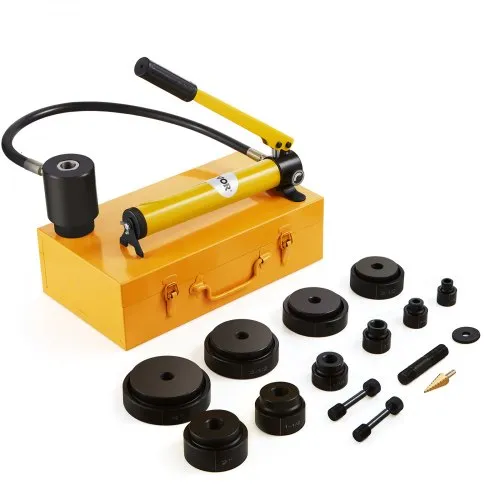
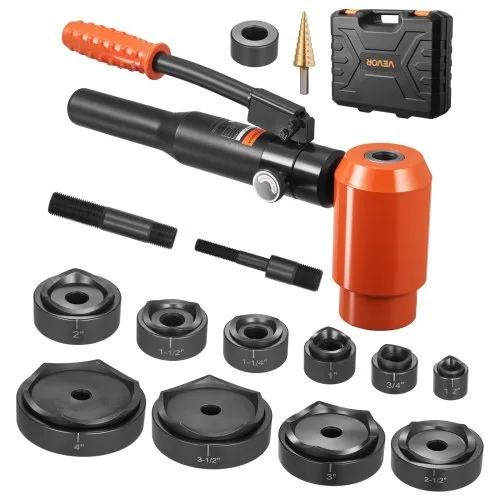
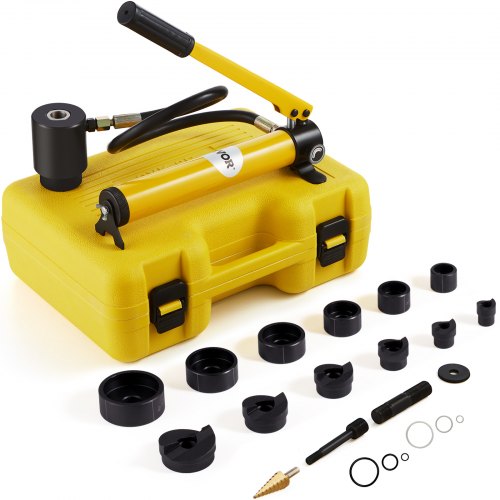
A standard VEVOR hydraulic knockout punch kit includes a hydraulic pump, hydraulic cylinder, draw studs, a carrying bag for on-site mobility, and a punch-and-die set in various sizes. Numerous kits accommodate punches with diameters ranging from ½ to 4 inches, covering everything from conduit knockouts to large cable entry holes.
Hydraulic kits are nearly always more practical than manual knockout sets when working with stainless steel or materials thicker than 3 mm. They are also much safer because of the regulated force delivery, which greatly reduces the chance of punch fracture under load. A hydraulic kit is a valuable core investment if your punches & nail setters toolset must frequently handle tough industrial applications.
Center Punches and Automatic Center Punches: Precise Drill Point Marking
Accurately identifying the drill point is crucial for eliminating bit wander and ensuring precise hole placement before drilling metal, wood, or composite materials. Center punches create a tiny depression that precisely positions the drill bit where it is needed for clean, precise work. The finely honed tip angle of VEVOR’s Center Punches, which are constructed of hardened tool steel, ranges from 60° to 90°, depending on whether you are marking for spot drilling or normal twist drills. Standard center punches are straightforward, sturdy, and dependable on almost any surface because they only need a hammer hit to make the indent. Because automatic center punches are spring-loaded, you can operate them with just one hand without a hammer.
Just press the tip against the surface, and the internal mechanism will automatically give a steady impact force. Because of this, they are particularly helpful when working on overhead surfaces, in cramped areas, or when quickly marking several locations during layout work. Both varieties are available in VEVOR’s wider selection of punches & nail setters; automatic models feature adjustable strike force settings that can be adjusted to match the hardness of the workpiece. Automatic center punches significantly minimize fatigue and expedite the layout process while ensuring uniform indentation depth for machinists, metal fabricators, and toolmakers who mark dozens of drill points per session.
Nail Setters and Pin Punches: Clean Finishing and Precise Pin Removal
Within the category of punches & nail setters, nail setters and pin punches play two very different but equally significant roles. The main applications for nail setters are in woodworking and finish carpentry. They enable you to drive nail heads slightly below the surface of the wood without damaging the surrounding wood, giving joints and trim work a polished, expert look.
VEVOR nail setters come in a variety of tip sizes that correspond to typical nail head diameters, ensuring the setter stays firmly in place on the nail head. Here, the cupped or concave tip design is crucial because it prevents the setter from skating off the nail upon impact, protecting your knuckles and the workpiece surface.
Drive Punches and Pin Punches are used to remove roll pins, clevis pins, hinge pins, and dowels from assembled components in metalworking, machinery maintenance, and gunsmithing. Pin punch sets from VEVOR are available in graduated diameter sets, usually ranging from 1/16 inch to ½ inch. This allows you to match the punch diameter closely to the pin being removed, preventing mushrooming and improving extraction cleanliness.
Starter punches, also known as roll pin punches, have a recessed tip made especially to sit on hollow roll pins, whereas drive punches have a flat, square-end tip for driving pins to a flush finish. Having both kinds in your collection of punches & nail setters ensures you can perform maintenance and disassembly duties correctly without causing component damage.
Choosing Punches & Nail Setters by the Job
This table starts from the task in front of you, names the tool to reach for, and flags the one spec and the one pitfall that decide the result.
| Job on Site | What to Reach For | Spec That Decides the Buy | What to Watch For |
|---|---|---|---|
| Conduit entries in a steel panel | 10 to 15 ton hydraulic knockout kit | Die size versus conduit trade size | Size the die to the conduit, not the cable |
| Holes in thick busbar or flat bar | 35 ton hydraulic bar puncher | Rated maximum plate thickness | Pump is sold separately, so budget for one |
| Drill-point marks on hardened metal | Automatic center punch | Adjustable strike-force setting | Ease force on thin stock to avoid dishing it |
| Flush nail heads in hardwood trim | Nail setter with a cupped tip | Tip size against the nail head | A cupped face stays put, a flat one slips |
| Driving roll pins from an assembly | Starter punch, then a pin punch | Punch diameter against the pin | Start just under the pin size to avoid mushrooming |
VEVOR Punches & Nail Setters by Power Source and Key Features
Beyond tool type, the power source and specific design elements of punches & nail setters significantly impact how well they perform in your setting, whether in a mechanical workshop, a carpentry shop, or an electrical panel on a project site.
Manual vs. Hydraulic: Choosing the Right Power Source for Your Application
In the punches & nail setters category, the decision between manual and hydraulic operation depends on the thickness of the material you deal with, the number of holes you need to punch, and the portability needs of your workplace. Compact and power-free, manual knockout punches and hand-operated center punches are ideal for sporadic use on light to medium-gauge steel, usually up to about 3 mm. For field electricians who require a small, portable solution for conduit knockouts in conventional enclosures, they are perfect. The high-torque draw bolts and hardened steel components in VEVOR’s manual sets deliver consistent performance throughout a long service life.
When punching heavier material often or when project volume demands speed and repeatability without operator fatigue, hydraulic hole punch tools and Hydraulic Knockout Punch Kits are the best option. The hydraulic variants from VEVOR include sturdy cylinders that withstand thousands of working cycles and pump designs that effectively increase pressure with minimal effort at the handle. The control provided by a hammer and nail setter combination is actually an advantage for woodworkers and finish carpenters, as it allows you to feel the resistance of the material and gauge how deeply the nail head is being set. Nail setters are designed to be completely hand-operated. The most important thing to look for is tip hardness: VEVOR nail setters employ hardened tips that do not break even when hammered repeatedly, guaranteeing the accuracy of the cupped face even after years of use. Consider the handle or grip material when evaluating any VEVOR punch or setter. While knurled steel handles on pin punches and drive punches offer the solid, non-slip grip required for precise striking force, ergonomic, padded handles on automatic center punches & nail setters lessen hand strain during extended sessions. What differentiates a disappointing tool purchase from one that merits years of use in your kit is matching both the power source and feature set to your particular approach.
Key Features to Look for When Buying Punches & Nail Setters
Knowing which features are truly important can help you avoid purchasing punches & nail setters that function poorly or wear out too soon. Material quality is the single most important factor. Punches and dies manufactured from hardened alloy tool steel or chrome-vanadium steel hold their cutting edges significantly longer than cheaper mild steel alternatives, which deform quickly under repeated impact loads. Raw hardness is important, but so are tip shape and accuracy. Every time you use a knockout punch with a little off-center or improperly ground die, you will have to spend time cleaning and filing the ragged holes. From the first punch to the thousandth, VEVOR’s punches & nail setters consistently produce clean results because they precisely grind to tight tolerances.
Verify the contents of the kit for sets. In addition to the punch heads, a full hydraulic knockout punch kit should have a hydraulic cylinder, a draw stud, several punch and die sizes, and a carrying case. You have to buy accessories separately for incomplete sets, which increases costs and delays. VEVOR’s sets come with everything you need to get to work right out of the box.
Lastly, whether your workplace involves wetness, cutting fluids, or outdoor conditions, consider corrosion resistance. Compared to bare steel, tools with a black oxide or phosphate finish are much more resistant to rust. Well-finished punches & nail setters will last for years without pitting or seizing when properly stored in a case or roll pouch, safeguarding both performance and long-term value on every project.
Best-Seller Comparison
The five tools below are the current top listings in the catalog, compared on the specifications that actually separate them.
| Product | Tool Format | Force Output | Hole Size Range | Dies / Punches | Material Compatibility | Best For |
|---|---|---|---|---|---|---|
| 35-Ton Hydraulic Bar Puncher | Single-station bar puncher | 35 ton | 3/8" to 3/4" | 4 pairs of dies | Iron, copper, aluminum, stainless steel plate and bar | Only tool here that punches solid bar and 10 mm plate; busbar and structural steel |
| 15-Ton Enclosure Knockout Set | Enclosure knockout set | 15 ton | 1/2" to 4" | 10 dies | Steel electrical, control, and switch cabinets | Widest hole range aimed at steel enclosures; switchgear and control-panel builds |
| 15-Ton Conduit Punch Driver Kit | Conduit driver kit | 15 ton | 1/2" to 4" | 10 dies | Aluminum, brass, stainless steel, fiberglass, plastic | Same 4-inch reach but rated across metals and plastics; mixed-material conduit entries |
| 10-Ton Conduit Punch Kit, 6 Dies | Conduit driver kit | 10 ton | 1/2" to 2" | 6 dies | Aluminum, brass, stainless steel, fiberglass, plastic | Lighter kit for conduit up to 2 inches; everyday electrical work without a 4-inch set |
| Ratchet SLUG-Buster Knockout Set | Ratchet knockout set | Manual ratchet | 1/2" to 2" | 6 dies | Aluminum, mild steel, fiberglass, plastics | Only no-hydraulics option here; ratchet drive for quick 2-inch holes where portability wins |
Why Choose VEVOR Punches & Nail Setters?
From hydraulic knockout punch kits for heavy steel panels to precision nail setters for faultless finish carpentry, VEVOR’s punches & nail setters line meets every striking, setting, and punching demand. Hardened steel construction, ergonomic design, and reliable performance are the main considerations in the production of every tool. VEVOR provides tradesmen and do-it-yourselfers with all they require, including affordable pricing, extensive set options, and dependable after-sales service. Discover the ideal tool for your upcoming project by looking through the entire collection.
FAQs
What is the difference between a knockout punch and a center punch?
In a single operation, a knockout punch makes a clean, whole hole in sheet metal. To guide a drill bit at the beginning of drilling, a center punch makes a tiny indentation. They have different functions: one marks a starting point, while the other removes items.
What gauge of steel can a manual knockout punch set handle?
On mild steel up to 3 mm thick, the majority of manual knockout punch sets, including VEVOR versions, function dependably. A hydraulic knockout punch kit is recommended for high-volume applications, heavier-gauge steel, or stainless steel to deliver clean results with less operator effort.
When should I use a hydraulic knockout punch kit instead of a manual set?
When punching steel thicker than 3 mm, when you need to make many holes quickly, or when working in confined areas where applying torque by hand is challenging, use hydraulic tools. Hydraulic tools produce cleaner holes with a lower risk of punch or die damage, as they consistently apply force without wearing out.
What tip sizes do nail setters come in, and how do I choose?
The tip sizes of nail setters usually match the diameters of ordinary nail heads and range from 1/32 to 5/32 inch. To ensure the setter seats firmly without slipping or leaving marks on the nearby wood surface, use a tip slightly smaller than the nail head.
Can pin punches and drive punches be used interchangeably?
Not ideally. For smooth pin driving through bores, pin punches feature a reduced-diameter tip. For flush pin placement, drive punches feature a flat, full-diameter tip. It is advised to have both types in your punches & nail setters, as using the wrong type can damage the pin or the workpiece.
Can you recommend the best nail punch tools for finishing work?
For finish carpentry, choose a nail setter with a cupped or concave tip that grips the nail head and sinks it just below the wood without bruising the surface. Keep two or three tip sizes on hand so each matches its nail gauge. Browse the complete punch and setter range to compare options.
What are the different types of nail punch tools available?
The main striking and setting tools are knockout punches for cutting holes in sheet metal, center and automatic center punches for marking drill points, nail setters for sinking nail heads, and pin or drive punches for removing fixed pins. Each is built for one specific job rather than general use.
How do I choose the right nail punch for my project?
Match the tool to the task and the material. Use a nail setter sized just under the nail head for trim, a 60 to 90 degree center punch for drill marking on metal, and a graduated pin punch for driving out pins. The knockout punch set line covers clean holes in sheet metal.
Can you recommend the best long punches for heavy-duty work?
For heavy-duty punching, hydraulic tools carry the load. A 35 ton hydraulic bar puncher drives clean holes through thick plate and busbar, while 10 to 15 ton hydraulic knockout kits handle conduit holes in steel enclosures. Hydraulic force beats manual effort once the material passes about 3 mm.
How do I choose the right punch set for my workshop?
Base it on your typical material, hole sizes, and volume. Pick a hydraulic knockout set for frequent or thick-steel work, a ratchet set for occasional holes and portability, and confirm the kit includes dies, draw studs, and a case so nothing is missing on the first job.