Pipe & Tube Benders




Results for Pipe & Tube Benders
A pipe and tube bender is a tool that forms straight pipe or tubing into a curve or angle without kinking, flattening, or cracking the wall. It holds the material against a shaped die or a set of rollers and applies controlled force so the metal flows around the curve while the inside diameter stays open. Keeping that diameter intact matters because a collapsed section restricts flow and weakens the run. The tool turns repeatable measurements into repeatable bends, which saves time over cutting and joining fittings and gives cleaner lines.
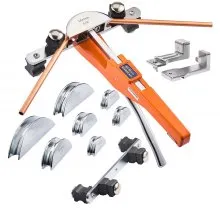
Pipe and tube benders fall into manual and electric groups. Manual tube benders range from 3-in-1 lever models for 1/4 to 1/2 inch tubing and ratcheting benders for 1/4 to 7/8 inch to a hand-cranked roller bender with six dies for pipe up to 1-1/2 inch. Electric benders run from a 750W hydraulic model for 1 to 1-3/4 inch pipe to 1500W machines with 9 round and 8 square dies, with round dies up to 3 inches. Tube roller benders form curves and circles in round and square tube and flat bar. Typical uses are plumbing and HVAC lines, handrails, exhaust and roll cage work, and metal furniture frames.
Four things decide what you need:
- Tube material: soft copper and aluminum suit manual benders, while steel and stainless suit electric ones.
- Outside diameter: match the die to the tube size, from 1/4 inch hand benders up to 3 inch electric die sets.
- Bend style: lever and ratcheting benders form angles, while roller benders form wide curves and rings.
- Power and space: manual benders need no power, while electric machines need a 110 V or 220 V supply and floor space.
Browse the full Plumbing Tools range for related tools, or visit the wider Plumbing category.
Pipe and Tube Bender Types at a Glance
Benders differ most in how force is applied, which tube sizes they accept, and how many dies come with them, so the comparison below sets those factors side by side.
| Bender Type | Power Source | Tube Size Range | Die Set | Trade-offs |
| Manual lever and ratcheting benders | Hand lever or ratchet | 1/4 to 7/8 in | 3 to 7 dies | Portable and power-free, but suited to soft tube in small sizes |
| Manual roller benders | Hand crank | Up to 1-1/2 in | 6 dies, round and square | Forms curves and rings, but hand cranking suits low-volume work |
| Electric hydraulic benders | 750W motor with 6L hydraulic cylinder | 1 to 1-3/4 in | 3 round dies | Steady powered force on casters, but hydraulic oil is added by the user |
| Electric die-set benders | 1.5 kW or 1500W motor | 5/8 to 3 in | 5 dies, or 9 round and 8 square | Widest size range and repeatable bends, but heavy floor-standing machines |
VEVOR Pipe & Tube Benders for Clean and Accurate Bends Every Time
Are you looking for a safe way to bend metal, steel, or copper tubing without breaking it or flattening it? You have full control over every bend angle with VEVOR pipe & tube benders. Every type of plumber, fabricator, HVAC technician, or weekend builder can find a VEVOR bender that works with the materials you use and the size of your job.
Manual, Electric, and Roller Options for Every Bending Job
You can choose the right type of bender based on the material, how often you want to bend it, and how your workspace is set up. VEVOR offers a wide range of pipe & tube benders, so you can get the right tool for the job without any problems.
Manual Tube Benders for Light and Medium Fabrication Work
People who work in the trades or do their own projects and need to make clean bends in copper, aluminum, or thin-wall steel tubing should use a hand tube bender. Heavy-duty cast iron or steel frames make up VEVOR manual tube benders, which come with a variety of die sets to bend tubes of different sizes. Operation is simple: insert the tube into the die, align it with the mark for the angle you want, and then use the lever to bend it.
For job sites without electricity, manual benders are easy to use because they don't require a power source. These tools are small and light, so they're easy to carry around in a tool bag or on a van shelf. Clear degree marks on VEVOR manual benders make it easy to get the angle you want on the first try.
Plumbing rough-ins, fridge line work, handrail fabrication, and bending brake lines for cars are all common uses. A hand tube bender from VEVOR is a reliable and inexpensive pipe & tube bender that will last for years of regular use if you only bend tubing sometimes and work with soft metals.
Electric Tube Benders for High-Volume and Heavy-Duty Work
If you need to bend larger materials consistently or make many items, an electric tube bender is the right tool. Electric tube benders from VEVOR use a powered drive system to maintain steady, controlled force throughout the bend cycle. The end result is always a smooth, even bend that requires no physical effort.
Electric models can work with a wider range of diameters of steel, stainless steel, aluminum, and copper tubing than manual versions. With VEVOR's electric tube benders, workers can make the same bend correctly over and over again during a full production run thanks to their adjustable die sets and angle stops. Fabrication shops, car builders, exhaust system makers, and furniture makers who work with metal tube frames will love these machines.
Foot pedal controls and overload protection are safety features that help keep workers safe during extended use. If your job requires bending a lot of tubing or hard materials, an electric tube-bending machine from VEVOR is a good buy that saves you time and effort right away.
Copper Tube Benders for Plumbing and HVAC Applications
If you need to bend soft or semi-rigid copper tubing for plumbing, HVAC, or cooling systems, you can use a copper tube bender. By design, VEVOR copper tube benders make tight, smooth turns without flattening or collapsing the tube wall. It is very important to keep the tube's internal diameter constant, as any change in it limits flow and makes the system less effective.
For different job needs, VEVOR has copper tube benders with both spring-style and lever-style handles. For making gentle curves in small areas where a bigger tool won't fit, spring benders are helpful. These benders let you adjust the bend position more easily and are better for fine work on longer tube runs.
In both home and business setups, both types can work with standard copper tube sizes. For most options, plumbers and HVAC technicians should have both types in their toolbox. VEVOR copper tube benders are made from steel that has been strengthened so that they don't wear out and stay accurate even after being used a lot on tough job sites.
Tube Roller Benders for Curves and Scrolls in Metal Fabrication
Instead of making sharp angles, a tube roller bender makes smooth curves and circles. People use VEVOR tube roller benders to make decorative ironwork, furniture, building metalwork, and custom cars. As the tube goes through the machine, three movable rollers hold it and slowly curve it into a smooth shape.
By moving the center wheel, you can change the radius of the curve. With the right die set, tube roller benders can work with round, square, flat bar, and angle iron. Heavy-duty steel frames and precisely machined rollers keep VEVOR roller benders from slipping and ensure regular results.
There are both motorized and hand-cranked versions of these tools, with the motorized version better suited for production settings. A VEVOR tube roller bender gives you the control and ability to get the job done quickly and cleanly, whether you're making decorative metalwork, curved handrails, circular frames, or anything else that needs a long, sweeping bend.
Choosing a Pipe and Tube Bender by Tube Material
The tube you plan to bend, not the job alone, decides which bender will work, so the table below pairs common materials with the bender that suits them, the capacity to check, and the main risk.
| Tube Material | Suitable Bender | Capacity Check | Main Risk | Buyer's Note |
| Copper for HVAC and plumbing | Ratcheting or lever copper bender | Die matched to a 1/4 to 7/8 in outside diameter | Kinking or wall collapse | Bend slowly with a matched die so the wall holds. |
| Aluminum tube | Manual roller bender | Wall up to 4 mm, size up to 1-1/2 in | Overloading the hand crank | Stay within the rated wall before moving to electric. |
| Thin-wall carbon steel and square tube | Manual roller bender | Wall up to 2 mm, size up to 1-1/2 in | Overloading the hand crank | Choose the square dies for square tube and flat bar. |
| Heavier steel and stainless | Electric hydraulic bender | Wall up to 5 mm, 1 to 1-3/4 in | Springback after the bend | Steady powered force limits springback on tougher tube. |
| Mixed round and square production runs | Electric die-set bender | Round to 3 in, square to 2 in, thin wall | Using the wrong die between sizes | Swap to the matching die each time to repeat bends. |
Flow Rate & Features Guide for Pipe & Tube Benders
You can choose a pipe & tube bender that works well when you need it by knowing how much it can bend and other important features. The right specs keep you from making mistakes that cost a lot of money and waste time.
Bend Capacity and Diameter Range Explained
This number tells you how big a tube and how thick the wall can be that a bend can handle without breaking the material or the tool. The ratings for VEVOR pipe & tube benders are based on the outside diameter of the tubes, which can range from 0.5 inches to 2 inches or more, depending on the type. The thickness of the wall is also important because it takes more force to bend a thick wall cleanly.
Always compare the capacity number to the type of tubes you want to use. Thin-wall copper hand benders won't work well with heavy-wall steel. Picking the right capacity range from the start helps keep tools from breaking and makes every job go more smoothly.
When you look at VEVOR pipe & tube benders, the capacity information is obvious, so you can easily compare models and pick the right size range for your materials. Make sure you understand the outside diameter and wall thickness before you add a bender to your cart.
Key Features That Improve Bending Accuracy and Ease of Use
Robust construction and features that speed up and improve the bending process are what make the best pipe & tube benders. The bending die has degree marks that let you hit exact angles without measuring each one separately. When throughput is high, quick-release devices speed up loading and unloading the tube between bends.
Multi-die sets that come with the tool make it more useful without costing extra. Manual benders with ergonomic handles make long work times less tiring. Digital angle readouts on electric tube benders take the guessing out of difficult jobs that need to be done perfectly.
When VEVOR makes pipe & tube benders, they include these useful features to ensure the tools work the way a professional would expect. Having the right features is important whether you are making one bend or one hundred bends. They separate stressful work from quick, accurate results.
Pipe and Tube Benders Best-Seller Comparison
The five best sellers below are four electric benders and one manual roller, so compare motor, tube size range, and the dies in the box against the tube you bend most.
| Product | Bender Type | Motor Power | Tube Size Range | Dies Included | Weight | Best For |
| Electric Pipe Bender, 9 Round, 8 Square Dies | Electric die-set, closed cover | 1500 W | Round 5/8 to 3 in, square 5/8 to 2 in | 9 round, 8 square | 573 lbs gross | Only closed-cover unit; shops that want the drive enclosed |
| 750W Hydraulic Electric Tube Bender | Electric hydraulic | 750 W | 1 to 1-3/4 in | 3 round | 224.9 lbs net | Only hydraulic model, on casters; small workshops that move the bender |
| Manual Tube Roller Bender, 1-1/2 in | Manual roller | Hand crank | Up to 1-1/2 in | 6, round and square | 79.8 lbs net | Only manual machine and the lightest; curves and rings with no power supply |
| 1.5 KW Electric Tube Bender, 5 Dies | Electric die-set, dual mode | 1.5 kW | 5/8 to 1-1/2 in | 5 dies | 584.2 lbs net | Only unit with automatic mode and a foot switch; repeat bends in production runs |
| 1500W Electric Pipe Bender, Open Design | Electric die-set, open design | 1500 W | Round 5/8 to 3 in, square 5/8 to 2 in | 9 round, 8 square | 516 lbs gross | Open-design twin of the closed unit with the same dies at a lower shipping weight |
Why Choose VEVOR Pipe & Tube Benders?
When it comes to bending, VEVOR pipe & tube benders can handle everything from light copper plumbing work to heavy steel production. At reasonable prices, you can find manual, electric, roller, and copper-specific versions. We make sure that every bender works well with the materials you use every day. Every VEVOR product comes with reliable customer service after the sale, so your purchase is safe. Today, go to VEVOR.com to find the best pipe & tube bender for your shop or job site.
FAQs
What is the difference between a tube bender and a pipe bender?
Tube benders are designed for use with thin-wall tubing used in HVAC, refrigeration, and car repair. Handle thicker-walled pipes used in water and building projects with pipe benders. The thickness of the walls and the material's hardness are the main differences. For clean, exact bends, always use the right tool for the job.
Can I bend stainless steel with a manual tube bender?
A heavy-duty hand tube bender can bend light-gauge stainless steel, but it takes more work than copper or aluminum. If you want to bend bigger stainless steel tubes, you should get an electric tube bender. It gives you the steady force you need without springback issues.
What tube sizes do VEVOR benders support?
The outer diameters that VEVOR pipe & tube benders can handle range from 0.5 inches to 2 inches, depending on the model. Many units come with multiple sets of dies for different sizes. Before you buy, check the product specs on VEVOR.com to confirm the diameter range.
How do I prevent kinking when bending copper tubing?
When you bend a copper tube, make sure the die size matches the tube outside diameter exactly. Kinking is more likely to occur if you bend too quickly or use a die that is too large a radius for the job. Inserting a copper tube bender, which looks like a spring, into the tube helps support the wall during the turn and prevents it from falling apart.
Can you recommend the best tube benders for DIY enthusiasts?
For DIY work, a manual bender is the best fit: lever or ratcheting models for 1/4 to 7/8 inch copper and aluminum tubing, or a hand-cranked roller bender up to 1-1/2 inch. They need no power and suit occasional jobs. See VEVOR manual tube benders.
Can you recommend the best tube benders for professional use?
Professionals who bend steel or run production should choose an electric bender. VEVOR's 1500W die-set machines carry 9 round and 8 square dies, and the 1.5 KW model adds automatic mode and a foot switch for repeatable bends. Keep a manual copper bender for field HVAC work.
What are the best tools for bending metal pipes at home?
At home, a manual lever or ratcheting bender handles copper and aluminum pipe up to 7/8 inch, and a hand-cranked roller bender forms curves in steel and aluminum tube up to 1-1/2 inch. Match the die to the outside diameter. Browse tube roller benders.
How do I choose the right tube bender for my plumbing project?
Choose by tube material and size: soft copper plumbing lines suit ratcheting or lever benders with the die matched to the outside diameter, while thicker steel pipe suits electric benders. Check wall thickness against the model's capacity. See more plumbing tools.
Which electric pipe bender is best for small workshops?
The 750W hydraulic electric bender suits small workshops because it rolls on casters and bends 1 to 1-3/4 inch pipe up to 180 degrees. Hydraulic oil is not supplied, so have it ready before first use. See the 750W hydraulic model.