AU.jpg?x-oss-process=image/format,webp)


Looking for a hydraulic cylinder that gives you reliable force for heavy-duty jacks, agricultural machinery, or tractor work? VEVOR offers single- and double-acting models in a wide range of capacities, from 20-ton units for less demanding work to 60-ton hollow-plunger cylinders for heavy industrial use. Each hydraulic cylinder features a rugged steel housing, an accurately machined rod, and a dependable seal to withstand repeated cycling at high loads without leaks or pressure loss. VEVOR’s hydraulic cylinders provide reliable performance for every application, from replacing a tractor top link to lifting heavy equipment and creating bespoke hydraulic systems.
Do you want to replace a worn-out top link or add jacking functionality to your equipment lineup? Hydraulic cylinders use a piston rod that extends or retracts to convert fluid pressure into mechanical force to lift, push, or pull heavy loads precisely. VEVOR hydraulic cylinders come in a variety of sizes, from 20-ton single-acting jacks for general lifting to 60-ton hollow-plunger models intended for industrial, agricultural, and tough tractor applications where reliable, constant force is essential.
Whether a cylinder suits your application depends on two key factors. These include the force production rating and whether it is single-acting or double-acting.
A single-acting hydraulic cylinder jack uses gravity, spring tension, or the load's weight to retract the piston rod when fluid pressure is removed. Single-acting cylinders are usually less expensive and simpler to maintain than double-acting units due to their simpler design.
These are perfect for tasks requiring force in only one direction, such as jacking equipment off the ground for service access, pressing material down, or lifting a load vertically. Presses, jacks with passive retraction, and simple lifting devices frequently employ single-acting cylinders.
A portable hydraulic solid jack based on the single-acting principle offers straightforward operation for field repairs, agricultural equipment maintenance, or general shop use when you need a compact, reliable lifting tool without the added complexity of a return-stroke hydraulic circuit.
The primary drawback is that because retraction force and speed depend only on gravity or load weight, single-acting cylinders may be less reliable for applications that need controlled movement in both directions.
A double-acting hydraulic cylinder uses fluid pressure to drive both extension and retraction, applying controlled force in either direction without gravity or spring return. Because it lets operators control piston-rod movement throughout the stroke, it is important for applications that require controlled placement rather than one-way lifting.
Compared to single-acting versions, this design necessitates two fluid ports and a more intricate hydraulic circuit. However, the additional control makes it a superior option for presses, tractor attachments, and similar devices where the rod must actively push and pull under pressure.
A typical construction method for double-acting units is the welded cross tube hydraulic cylinder, which uses a cross tube welded to the cylinder barrel as a mounting point to distribute load tension uniformly throughout the housing rather than concentrating it in one spot. For equipment that is regularly subjected to heavy cycling, this design increases durability.
Double-acting designs often offer better control and longer component life than single-acting units for any hydraulic cylinder application requiring back-and-forth motion under load.
The greatest force a cylinder can safely produce is indicated by its tonne capacity; choose the right size by matching that load to your heaviest actual use, with adequate headroom. A 20-ton hydraulic cylinder jack provides enough force for most farm and shop applications without needless bulk, covering a wide range of standard lifting, pressing, and light industrial work.
Stepping up to a 30-ton hollow plunger hydraulic cylinder offers substantial capacity for heavier machinery work, and the hollow plunger design lets a rod or bolt pass through the middle of the cylinder for specialized pulling and tensioning applications, not just straight pushing force.
For heavy industrial and equipment work, a 50-ton hydraulic ram cylinder provides substantial pushing power for pressing operations, structural work, or moving very large loads that lighter cylinders cannot safely manage.
For the most difficult jobs, a 60-ton hollow-plunger hydraulic jack at the top of the range offers the highest force. It is widely employed in heavy construction, bridge building, and large-scale industrial maintenance where failure is not an option and rated capacity necessitates a comfortable safety margin above the actual working load.
A hollow plunger hydraulic cylinder, unlike traditional push-style cylinders, has a center bore that runs the length of the piston-and-rod assembly. For tensioning, pulling, or bolt-stretching applications not feasible with solid-rod cylinders, this design lets a threaded rod, cable, or bolt pass through.
This design makes possible applications that a typical hydraulic cylinder is not made to handle by pulling through the center of the cylinder rather than pushing against an external surface. This arrangement is very useful for heavy equipment repair, cable tensioning, and structural construction.
The port arrangement is another particular thing to check before purchasing. Because the SAE 6-port hydraulic cylinder's standard fitting size ensures compatibility with common hydraulic hoses, fittings, and power unit connections, you are less likely to need additional adapters when integrating it into an existing hydraulic system.
For technical applications that require pulling force, through-bolt access, or compatibility with standardized fittings, selecting the right hydraulic cylinder arrangement for your mechanical system is as crucial as tonnage and acting type.
The best design depends on how and where the cylinder is fitted, in addition to the core parameters.
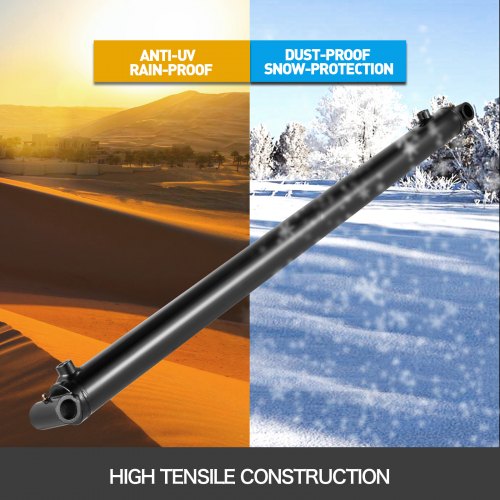
Farm equipment puts unique demands on hydraulic components since it is continuously exposed to dirt, moisture, and vibration in the field. An agricultural hydraulic cylinder's sealed, corrosion-resistant components are typically rated for outdoor use rather than merely typical industrial or shop use.
Replacing a worn top link is one of the most popular applications in agriculture. Instead of twisting a mechanical top link every time an attachment needs repositioning, a tractor's hydraulic cylinder lets operators adjust the implement angle from the driver's seat. This simplicity matters most for operators who switch between multiple tools during the workday.
On a three-point hitch, a tractor hydraulic top link cylinder can replace the mechanical top link. This allows remote hydraulic control of the cultivator angle, plow depth, and other implement positions without having to get off the tractor.
Lessee who want to spend less time dismounting for manual adjustments often choose this modification. Agricultural cylinders power loader arms, backhoe attachments, top links, and other tools that need steady, reliable thrust in unclean field conditions.
To ensure a proper fit and safe operation, top link cylinders come in defined category sizes that match various tractor hitch classes. With smaller pin diameters and a shorter overall length to match Category 1 three-point hitch dimensions, a hydraulic top link Cat 1 is designed for smaller tractors, usually in the compact to midsize range.
To manage the higher forces and larger implements typical of larger equipment, larger tractors usually require a hydraulic top link Cat 2, which features larger pin sizes and an extended length. Using a category cylinder that is too small can cause poor fit, excessive play, or early wear on mounting pins.
Many hydraulic top links have a check valve, which keeps the implement in place if hydraulic pressure drops and prevents sudden drops that could damage equipment or create a safety issue during operation. For tools where unexpected movement could cause injury or damage, this safety function is very helpful.
To ensure safe, dependable performance for your specific tractor-implement combination, make sure the hydraulic cylinder you choose for top link replacement is the correct category size and includes a check valve.
VEVOR offers a wide variety of hydraulic cylinder options, including top-link and hollow-plunger forms for tractors and agricultural equipment, single- and double-action designs, and capacities ranging from 20 to 60 tons. Farmers, technicians, and shop owners can purchase dependable parts at a reasonable cost, since each cylinder is priced to deliver industrial-grade force and durability without the markup typically associated with specialty hydraulic equipment companies. VEVOR offers hydraulic cylinders designed and rated for the job, whether you're adding heavy-duty jacking capacity to your shop or repairing a tractor top link. Browse the full collection now.
Double-acting cylinders are more controllable in applications that require active push-and-pull action because they use hydraulic pressure in both directions. Single-acting cylinders extend and are then passively retracted by a spring or gravity when pressure is released.
Match the rating to your maximum realistic load with lots of headroom. Most heavy industrial or structural work needs 50 to 60 tonnes, while everyday lifting and agricultural work sometimes needs 20 to 30 tonnes.
Because a hollow plunger cylinder has a center bore that may accommodate a rod, bolt, or cable, it can be used for tensioning, pulling, and bolt-stretching tasks that regular solid-rod cylinders cannot perform.
Select the category that corresponds to the three-point hitch class of your tractor. Larger tractors with greater force requirements and larger implements fit into category 2, while smaller tractors with smaller pin diameters fit into category 1.