Baseball & Softball Pitching Trainers




Results for Baseball & Softball Pitching Trainers
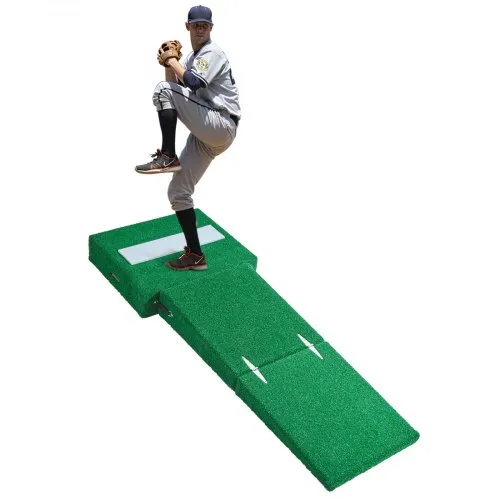
A pitching trainer is a portable mound or platform that gives a pitcher a raised, turf-covered deck with a rubber to push from, so a full delivery can be rehearsed away from the diamond. A wood or foam core holds the slope, and the turf on top grips the plant foot. Coaches, travel teams, school programs and parents use them in gyms, garages and backyards. Unlike a flat mat, a mound teaches the downhill drive that a pitcher meets in games.
Full-length game mounds stretch past 10 ft in two halves for a complete stride from rubber to landing. Hinged folding mounds fold on a stainless steel hinge and lift by carry handles between fields. Cross-braced folding mounds add a reinforced, adjustable base beneath the deck. One-piece game mounds use dense EVA foam with no seams, and compact pitching platforms run just over 2.5 ft long for warm-ups and rubber work. Wood-core decks carry 10 mm turf over a damp-proofed board, while foam-core decks wear thicker 12 mm turf. Every mound here is rated for 550 lb and works on grass, dirt, concrete and gym floors. High school pitchers, travel ball squads, softball players and parents running backyard bullpens choose by stride length, storage space and how far the mound must travel.
Five things decide which one fits:
- Stride room: how far a pitcher can stride before stepping off the deck.
- Rise height: how high the top of the mound sits above the floor.
- Base core: what lies under the turf to hold the slope.
- Fold style: how the deck breaks down for storage.
- Moving weight: how heavy the mound is to shift between sessions.
Browse every pitching mound here, then explore all baseball equipment.
Pitching Mound Types at a Glance
Each mound style is built differently, so the table below compares its core and turf, footprint and how it moves.
| Type | Core and Turf | Footprint | Carry Method |
|---|---|---|---|
| Two-piece game mound | 12 mm turf on high-density EVA foam | 127 x 48 in, two halves | Halves join with hook-and-loop strips, 154 lb |
| Braced folding mound | 10 mm turf on a 15 mm damp-proofed wood board | 85 x 30 in | Folds in half, carry handle, 58 lb |
| Handled folding mound | 10 mm turf on a 15 mm damp-proofed wood board | 77 x 29 in | Folds on a stainless hinge, carry handles, 45 lb |
| One-piece foam mound | 12 mm turf on high-density EVA foam | 42 x 34 in | One piece, 19 lb |
| Compact pitching platform | 10 mm turf on a 15 mm damp-proofed wood board | 31 x 30 in | Carry handle, 20 lb |
VEVOR Regulation-Grade Baseball Pitching Mounds for Every Training Level
Want to improve your pitching technique or set up a professional space for practice? A good baseball pitching mound is important for learning to throw properly, building muscle memory, and preparing for game conditions. VEVOR offers pitching mounds that meet league standards, are portable, and are built to last, features that coaches and players value for regular training.
Size, Construction Type & Regulation Standards
To choose the right baseball pitching mound, you must first know the exact size and construction requirements for your level of play. Ensuring your equipment complies with official standards is the first step toward effective training.
Understanding Regulation Pitching Mound Dimensions
Official baseball pitching mound rules change by age group and league level, so choosing the right size is essential for skill development. A portable baseball pitching mound for youth teams (ages 7 to 12) is usually 6 feet across and 6 inches high at the pitcher's plate. High school rules require the mound to have an 8-foot base and an 8-inch peak. College and professional rules say that the mound must have a 10-inch height and an 18-foot base circle.
To support proper pitching technique, the slope from the rubber to the front edge is generally recommended to be 1 inch per foot. When choosing dimensions, consider both your current needs and how you want to improve. For example, many training facilities buy adjustable or multiple mounds so they can work with people of all ages and skill levels.
Construction Materials That Impact Performance and Longevity
The materials used in your baseball pitching mound affect its performance, maintenance requirements, and overall lifespan. Artificial grass covers foam or rubber bases on turf pitching mounds, making them durable and relatively easy to maintain. They are perfect for indoor facilities and training centers that are open all year. When it comes to durability and weather resistance, rubber pitching mounds are the best.
Their high-density structure keeps their shape even after heavy use. These work well for outdoor fields when properly drained and maintained. An adjustable portable baseball throwing mound with modular construction lets you move it to different spots and store it between seasons. The engineers at VEVOR ensure that each material choice features reinforced edges that won't break and non-slip surfaces that keep pitchers safe during fast movements.
Meeting League Standards and Certification Requirements
Following the governing body's rules ensures that your investment supports legal training for competition. In terms of height, slope, and ball placement, official Little League rules differ from those of Babe Ruth, NFHS (high school), NCAA, and MLB. The dimensions of a softball pitching area are very different. It is usually flat rather than raised, and a 24-inch (61 cm) diameter pitching circle is marked on the ground.
Before you buy, make sure you know your league's rules, like the rubber distance (46 feet for Little League, 60 feet 6 inches for high school and up). Each VEVOR product comes with a full specification sheet that clearly indicates which league standards it meets. If your facility serves people of different ages, you might want to buy movable units that comply with the rules and can be placed at varying distances. Hosting a tournament requires certified equipment that meets the quarter-inch tolerance for many elite events.
Choosing Between Portable and Permanent Installation Options
Whether to get a portable or permanent baseball pitching mound depends on how often the field is used, how much space is available, and your budget. Portable baseball throwing mounds work well on fields used for multiple sports or events. These units usually weigh between 100 and 300 pounds and have wheels or handles that allow two to three people to move them. They're perfect for schools, community centers, and training centers that need to use rooms in different ways.
Permanent installations are more stable for training programs with many students and competitive areas, but they require grading and drainage systems installed by professionals. With VEVOR's portable options, you can store items outdoors when properly covered, and the structures are designed to stay strong season after season. Think about how many hours you use the facility each year. Facilities with more than 20 training hours per week may benefit from fixed installations, while part-time programs will get more out of high-quality portable systems that, with proper care, last 5 to 7 years.
Which Pitching Mound Fits Your Training
With the mound styles covered, match your pitcher and practice surface to the conditions below to choose one mound.
| Job | Confirm Before Purchase | Matching Specification | Recommended Product | Main Limitation |
|---|---|---|---|---|
| High school bullpen in a gym | You have helpers to move a 154 lb mound and room for a 127 in deck | 127 x 48 in two-piece EVA mound, 8.7 in rise, 12 mm turf | 127 in two-piece mound | Two halves to lift and join on site |
| Garage sessions for one pitcher | One pitcher sets up alone on a hard floor | 85 x 30 in folding wood deck, 58 lb, carry handle, adjustable base | 85 in braced folding mound | Carry handle only, no wheels listed |
| Patio drills with limited floor space | Your floor space fits a 42 x 34 in deck | One-piece EVA foam, about 3.9 in rise, 19 lb | 42 in seamless foam mound | Too short for a full-length stride |
| Warm-ups beside a batting cage | You only need the rubber and a short stride for warm-ups | 31 x 30 in wood board, 20 lb, carry handle | 31 in compact platform | Rise height not specified on the product page |
Setup & Maintenance
Your baseball pitching mound will last a long time if you place it correctly and maintain it regularly. VEVOR designs focus on being easy for anyone to set up and needing little upkeep. With simple tools, setting up a portable baseball throwing mound for the first time takes 15 to 30 minutes. Use a measuring tape to set the mound at the correct distance from home plate, then use ground stakes or heavy-duty bolts to hold it in place. For turf pitching mounds, brush the synthetic fibers once a week to keep them straight and prevent matting. Rubber pitching mounds need to be checked for surface cracks regularly and pressure-washed twice a season to remove dirt buildup. Make sure that the pitcher's rubber is still tightly attached and that the landing area doesn't have any depressions that could hurt someone before every practice. After it rains a lot, give the ground enough time to dry out and make sure flooding hasn't made it uneven. Keeping things in climate-controlled areas over the winter will help them last longer; stack portable units flat to prevent warping. VEVOR provides maintenance guides tailored to each material type, and replacement parts are readily available to help extend the equipment’s lifespan beyond the standard warranty period.
Best-Seller Comparison
Before ordering a mound, set the five best sellers side by side on stride room, rise height, base core, fold style and moving weight.
| Product | Stride Room | Rise Height | Base Core | Fold Style | Moving Weight |
|---|---|---|---|---|---|
| VEVOR 90 in Wheeled Folding Pitching Mound | 90 in long, 33 in wide | About 5.9 in (15 cm, calculated) | 15 mm damp-proofed wood board | Folds in half on a stainless steel hinge | 63 lb, rolls on built-in wheels |
| VEVOR 85 in Braced Folding Pitching Mound | 85 in long, 30 in wide | About 5.9 in at the back (15 cm, calculated) | 15 mm damp-proofed wood board | Folds in half, cross-braced base | 58 lb with a carry handle |
| VEVOR 42 in One-Piece Foam Pitching Mound | 42 in long, 34 in wide | About 3.9 in (10 cm, calculated), the lowest listed | High-density EVA foam | One piece, no folding | 19 lb, the lightest here |
| VEVOR 127 in Two-Piece Game Mound | 127 in long, 48 in wide, the longest here | 8.7 in (220 mm), the tallest here | High-density EVA foam | Two halves joined by hook-and-loop strips | 154 lb, the heaviest here |
| VEVOR 31 in Compact Pitching Platform | 31 x 30 in, the shortest here | Not specified on the product page | 15 mm damp-proofed wood board | Single board with rubber base pads | 20 lb with a carry handle |
Shop VEVOR Baseball Pitching Mounds for Professional Training Results
VEVOR has a wide range of baseball pitching mounds for all skill levels and budgets, from practice areas for kids to training grounds for professionals. Our products meet strict regulatory standards and offer the durability and portability required by modern training programs. We make it easy to build real training environments that help pitchers become winners by offering low prices and dedicated customer service. Browse our selection now and get tools for your field that will work year after year.
Frequently Asked Questions
What are the key features to consider when choosing a pitching mound?
Compare deck length with the pitcher's stride, then check rise height, core material, how it folds and how much it weighs to move. A load rating above your heaviest pitcher matters too. The 85 in folding mound is rated for 550 lb.
Can you recommend the best pitching mound for youth baseball teams?
For youth teams aged 12 and up, a mid-length folding mound covers most strides and moves easily between fields. Younger players can start on a short platform. The 90 in wheeled pitching mound folds on a hinge and rolls between practice spots.
How do I properly install and maintain a baseball pitching mound?
Set it on level ground, measure from the front of the rubber to home plate and keep the landing area clear. Brush the turf, let it dry after rain and store it indoors off-season. The two-piece 127 in mound joins with hook-and-loop strips.
How can I choose the right softball pitching trainer for beginners?
Beginners need a low platform that marks the rubber and stride without a steep drop, plus a light build for quick setup. Softball pitchers throw from flat ground in games. The 31 in pitching platform weighs about 20 lb.
What equipment is essential for practicing baseball pitching at home?
Start with a mound, a net or rebounder to stop throws, a strike-zone target, a bucket of balls and a tape measure to set distance. A catcher's mitt helps when a partner joins. The 42 in one-piece mound suits garages and patios.
What is the pitching distance for 10U softball players?
Most 10U fastpitch leagues, including USA Softball, set the pitching distance at 35 ft from the front of the rubber to the back point of home plate. Confirm with your league before marking it. The compact pitching platform suits flat-ground drills.