Bench Grinder Pedestal






Results for Bench Grinder Pedestal
VEVOR offers a wide selection of bench grinder stands for professional grinding applications, residential garages, and workshops. VEVOR's portfolio offers the stability, adaptability, and build quality your grinding operations require, whether you need a heavy-duty bench grinder stand for industrial sharpening work or a compact pedestal bench grinder for a home workshop. VEVOR guarantees that every system receives a robust, purpose-built base, with versions that support a wide range of grinder sizes and mounting configurations.
VEVOR Bench Grinder Stands: Heavy-Duty Pedestal Designs for Stable, Precise Workshop Grinding
Are you looking for a grinding stand that keeps your grinder at the ideal working height, prevents vibration, and withstands years of regular shop use without shifting or loosening? By converting a countertop grinder into a standalone workstation with an appropriate bench grinder stand, you can increase control, reduce strain, and free up valuable bench space for other operations.
Rock-Solid at Any Height: How Adjustability and Stability Separate Great Grinder Stands from Average Ones
A bench grinder stand must firmly support your grinder under load and precisely position it at your preferred operating height, which are the two most important performance variables. VEVOR uses technical decisions that go beyond basic tube diameter and base plate size to address both priorities in the construction of its supports.
Height Adjustment Range and Ergonomic Working Positions
One of the most frequent causes of operator tiredness and inaccurate work is working at the incorrect height on a bench grinding stand. A grinding wheel that's too low causes you to stoop forward and lose control of your tool angles. If it's too high, your sightlines to the task deteriorate, and your arms tire out quickly. For standing work, the optimal grinding height places the wheel center at around elbow height; depending on the operator, the ideal level is usually between 38 and 44 inches from the floor.
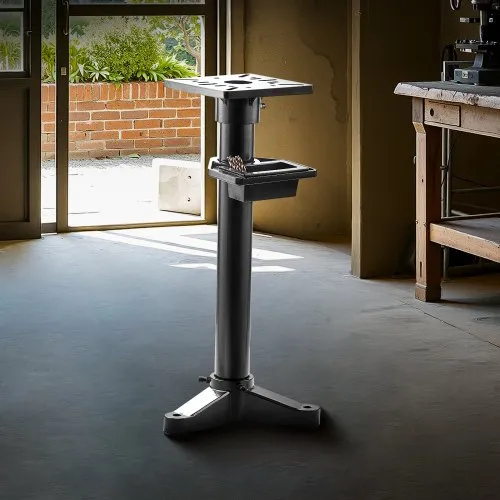
With telescoping column designs and height adjustment ranges from 33 to 51 inches on the majority of models, VEVOR's bench grinder stands cover the ergonomic operating range for operators from 5'2" to 6'4" without modification. A multi-position locking collar with a safe bolt-clamp mechanism allows height adjustment, fixing the column at the desired height without slipping under vibration.
Base Plate Design and Anti-Vibration Floor Anchoring
The primary stability component of a grinding stand is its base plate, whose shape, thickness, and anchoring features determine whether the stand remains stationary during vigorous grinding or moves across the floor under vibration loads. A wide, low-profile base lowers the center of gravity. It lessens the rocking tendency often seen in narrow-base designs by distributing the combined weight of the stand and grinder across a greater floor contact area.
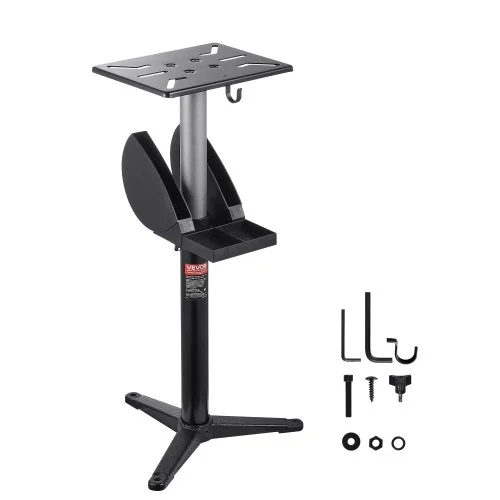
To provide a sturdy platform that doesn't tip even when lateral grinding pressure is applied to the wheel, VEVOR's heavy-duty bench grinder stand models feature a four-point base with an approximately 20 by 20-inch footprint on standard models. The stand can be securely fastened to workshop floors for optimal stability in production settings since each base leg ends in a pre-drilled floor anchor point that accepts wood screw fasteners or standard concrete anchor bolts.
Column Rigidity and Vibration Damping Under Load
In a bench grinding stand, vibration control is crucial in the vertical column connecting the base to the grinder mounting platform. The grinder can shift relative to the workpiece when a column flexes under grinding force, reducing accuracy and accelerating wheel wear. The quality of the joints between column sections, wall thickness, and tube diameter all affect column stiffness.
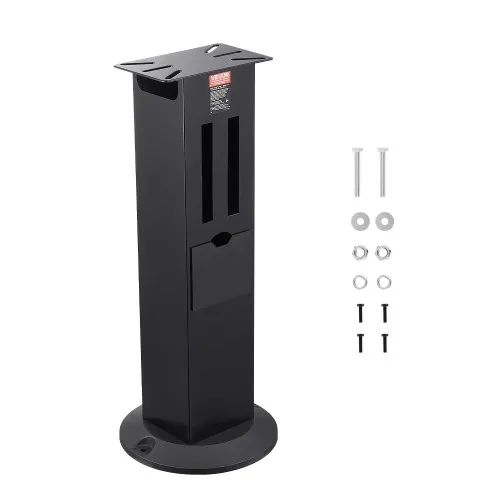
Heavy-gauge steel tubing with a minimum wall thickness of 2 mm is used in VEVOR's bench grinder stands. Full-penetration welds, rather than tack welds, are used to fuse the tubing to the base assembly and the higher mounting platform. Instead of a stack of interconnected parts that move at each joint, this building method produces a column assembly that functions as a single rigid unit.
Mounting Platform Dimensions and Grinder Footprint Coverage
To provide complete four-point support across the grinder's base, the upper mounting platform of a bench grinder stand must closely match the footprint of your specific grinder model. An excessively small platform causes the grinder to overhang its mounting surface, resulting in a cantilever condition that increases vibration and stresses the mounting hardware.
To meet the base footprints of the most popular 6-inch and 8-inch bench grinders, which are the two sizes most frequently utilized in both home workshops and commercial settings, VEVOR creates pedestal bench grinder mounting platforms with universal proportions.
Steel Built to Last: How Material Quality and Grinder Compatibility Define VEVOR's Grinding Stands
The quality of a bench grinder stand is determined by the steel used and how well it works with your grinder. VEVOR is a sensible option for workshops operating various equipment, as its stands are constructed from industrial-grade materials with compatibility features that cover a wide range of bench grinder brands and configurations.
Steel Grade, Coating Quality, and Long-Term Workshop Durability
Q235 structural steel, a low-carbon steel grade widely used in industrial fabrication for its combination of tensile strength, weldability, and surface finish quality, is used to make VEVOR's bench grinding stand variants. Because Q235 steel has a typical yield strength of about 235 MPa, VEVOR's supports can handle grinders up to 88 lbs on the mounting platform without experiencing joint stress or frame deflection under typical working loads.
For optimal adhesion and impact resistance, a high-build powder coat in a textured black finish is applied to the sandblasted steel surface of every VEVOR heavy-duty bench grinder stand. Workshop settings expose equipment to metal dust, coolant mist, grinding sparks, and sporadic tool impacts—conditions that rapidly remove poorer finishes. In workshop stands used daily for many years, VEVOR's powder coat maintains its protective integrity, preventing surface rust that jeopardizes both appearance and structural integrity.
Universal Grinder Compatibility and Brand Fitment
The ability of a bench grinder pedestal to be set up to accommodate your particular grinder model determines its practical value, and VEVOR's universal mounting platform design is designed to optimize that compatibility. The majority of 6-inch and 8-inch grinders from major brands use mounting configurations that can accommodate grinder base hole spacings ranging from 2.5 inches to 8 inches center-to-center in both directions, thanks to the expanded slot bolt pattern on VEVOR's mounting platform.
This universal fitment solution offers long-term value over platforms with fixed, brand-specific mounting patterns for workshops operating multiple grinder models or preparing for future equipment modifications. Certain variants of VEVOR's bench grinder also include a secondary accessory tray, a dedicated area for workshop supplies, wheel protectors, and dressing tools that must be accessible during grinding.
Why Choose VEVOR Bench Grinder Stands for Your Workshop?
The sturdy column design, height adjustability, base stability, and universal grinder compatibility of VEVOR's bench grinder stands are essential features for serious workshop users. Every VEVOR heavy-duty bench grinder stand is constructed from premium steel, manufactured to last, and priced to provide true value, whether used in a small home garage or a tough industrial grinding setting. Give your grinder the strong base it needs by browsing VEVOR's entire line of bench grinding stands and pedestal bench grinders today.
FAQs
What grinder sizes are compatible with VEVOR bench grinder stands?
VEVOR's bench grinder stands are designed to accommodate most 6-inch and 8-inch bench grinders. The universal mounting platform features elongated bolt slots covering base hole spacings from 2.5 to 8 inches, fitting the majority of major grinder brands without custom drilling or additional adapters.
Can VEVOR bench grinder stands be permanently anchored to the floor?
Yes. Every VEVOR bench grinder pedestal includes pre-drilled floor anchor points at each base leg, compatible with standard concrete anchor bolts and wood floor fasteners. Permanent anchoring eliminates stand movement during aggressive grinding and is recommended for production workshop environments.
What is the maximum height a VEVOR adjustable bench grinding stand can reach?
Most VEVOR adjustable bench grinder stands extend to a maximum height of 51 inches via the telescoping column and clamp-collar locking system. This covers ergonomic working height for operators up to approximately 6'4" and allows infinite height positioning within the full adjustment range.
How much weight can a VEVOR heavy-duty bench grinder support?
VEVOR's heavy-duty bench grinder stand models support grinder weights up to 88 lbs on the mounting platform. The Q235 steel frame and full-penetration welded joints distribute this load through the entire stand structure, maintaining stability and preventing frame deflection under normal grinding loads.
Do VEVOR bench grinder stands include anti-vibration features?
Yes. All VEVOR bench grinder pedestal models include rubber isolation pads fitted under each base contact point to dampen floor vibration transmission. The tight-tolerance telescoping column and rigid welded frame further minimize vibration amplification, improving grinding precision and reducing operator fatigue during extended sessions.