Download VEVOR App 

Exclusive AU $5.00 off for your first three orders on the App.
Scan the QR code to download
VEVOR provides a wide range of pipe plug kits designed for industrial equipment maintenance, plumbing applications, and hydraulic systems. Our all-inclusive kits include a variety of plug sizes and thread types to cap unused connections, seal ports, and prevent contamination during maintenance. VEVOR offers solutions that meet a range of pressure ratings, thread standards, and material requirements, whether you are maintaining heavy machinery, servicing hydraulic lines, or managing workshop inventory. Our pipe plug kits, which come with neat storage containers and affordable prices, help technicians and maintenance specialists complete sealing jobs effectively in commercial, industrial, and residential settings.
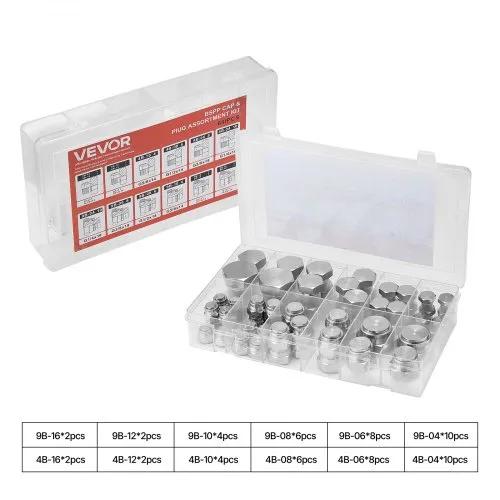
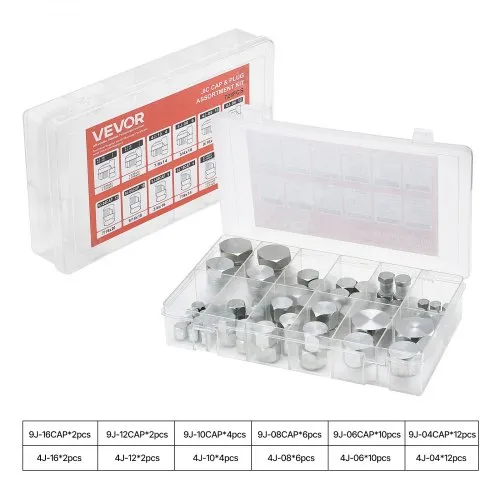
For your plumbing and hydraulic projects, are you looking for a wide selection of plugs that meet a range of thread sizes and pressure requirements? Having the appropriate sealing plugs on hand to cap lines, seal ports, and safeguard systems during equipment service is essential to the effectiveness of your maintenance operations. Pipe plug kits from VEVOR address the fundamental challenge of maintaining comprehensive, well-organized plug inventories that support various thread standards, including JIC hydraulic fittings, ORFS hydraulic fittings, BSPP hydraulic fittings, and DIN hydraulic fittings, for use across a range of industrial and mobile equipment.
You can perform any sealing activity without sacrificing system integrity or safety by choosing kits with the right size assortments and pressure capabilities.
Pipe plug kits cover most hydraulic and piping applications seen in maintenance work and usually consist of 50 to 300+ separate pieces with thread sizes ranging from 1/8-inch to 2-inch NPT or metric equivalents. To accommodate frequent usage and lost replacements, professional-grade kits arrange plugs by size increments, typically 1/8", 1/4", 3/8", 1/2", 3/4", 1", 1-1/4", 1-1/2", and 2". Each size includes many pieces. There are usually more pieces in the widely used sizes, such as 1/4" to 3/4", and fewer pieces in the bigger sizes that are less common in standard equipment. During urgent repairs, personnel can easily locate and retrieve the appropriate size thanks to the clearly labeled compartments in VEVOR's pipe plug kits.
Each size category's thread pitch and configuration have a direct bearing on regional standards and equipment compatibility. The majority of applications in North America use NPT (National Pipe Thread) tapered threads, which create mechanical seals through thread interference, often reducing the need for additional sealants in low-pressure applications when properly installed with compatible materials. Both European and Asian equipment use BSP (British Standard Pipe) threads; BSPP hydraulic fittings require bonded seals or O-rings, while BSPT (tapered) fittings work similarly to NPT. In hydraulic systems, where M10x1, M12x1.5, M14x1.5, M16x1.5, M18x1.5, M22x1.5, and M27x2 threads are frequently used to seal ports and unused connections, metric thread standards add additional coverage. To assist technicians in confirming compatibility before installation, comprehensive pipe plug kits include thread gauges or size identification charts.
Pressure ratings, which range from 1,000 PSI for low-pressure plumbing to 10,000+ PSI for mobile and industrial hydraulic systems, distinguish hydraulic-grade components from ordinary plumbing plugs. For many stationary hydraulic equipment applications and compressed air systems, standard steel pipe plugs rated at 3,000 PSI are appropriate. High-pressure versions made of hardened steel or specific alloys have PSI ratings of 6,000 to 10,000, which are necessary for industrial presses, construction equipment, and agricultural gear where system pressures frequently approach the upper end of common operating ranges.
The link between thread engagement, material strength, and pressure rating establishes long-term sealing reliability. As the plug tightens, tapered threads like NPT increase the interference fit, enabling higher pressure capabilities; a typical engagement requires 3.5 to 5 full thread turns to reach full-rated pressure capacity. To ensure thread form accuracy and materials that meet published pressure ratings across a temperature range from approximately -40°F to 250°F, typical of many mobile equipment applications, VEVOR manufactures its pipe plug kits in accordance with ANSI, SAE, and ISO regulations.
Equipment built to several international standards is commonly encountered in modern maintenance situations, necessitating plug kits that support diverse thread configurations. North American hydraulic systems frequently use JIC (Joint Industry Council) 37-degree flare fittings, which feature straight threads and metal-to-metal sealing at the flare interface rather than thread flank contact for pressure sealing. Depending on the DIN standard, metric DIN hydraulic fittings with 24-degree cone sealing surfaces or O-ring face seals predominate in hydraulic equipment in Europe. The O-Ring Face Seal (ORFS) fittings, which use straight threads for mechanical retention and elastomeric sealing achieved by O-ring compression against machined port faces, are gradually replacing JIC in high-pressure and high-vibration applications.
When maintaining a variety of equipment fleets, awareness of these differences helps avoid cross-threading damage and ensures appropriate sealing. Despite similar thread characteristics, a JIC plug generally cannot seal properly in a DIN port because of differences in cone angles and sealing mechanisms. Similarly, thread damage and faulty seals result from using NPT tapered plugs in BSPP parallel ports. Comprehensive pipe plug kits solve this problem by either explicitly marking thread types to avoid misapplication or by combining JIC hydraulic fittings thread standards with conventional pipe threads. For equipment repair specialists who work with a variety of equipment brands and origins, VEVOR offers kits designed exclusively for hydraulic maintenance that include the right JIC, DIN, and ORFS hydraulic fittings.
During repairs, efficient organizational systems in pipe plug kits significantly reduce selection time and help avoid installation problems. High-quality kits use boxes divided into compartments for each size. These cases often feature molded slits that hold plugs in place during transport and make it easy to see how much inventory remains. Color-coded anodizing for rapid visual differentiation, laser etching directly on plug faces, or embossed markings that maintain legibility even after frequent handling and fluid exposure are some techniques for identifying size.
The choice of materials and application-specific design elements ensures that plugs withstand environmental conditions and provide reliable sealing across a variety of industrial applications.
The most popular material for pipe plug kits is carbon steel, which provides a good strength-to-cost ratio and sufficient corrosion resistance for interior applications and systems that use petroleum-based fluids. In humid environments or when there is sporadic exposure to moisture, zinc-plated or black oxide finishes improve corrosion resistance and prolong service life. They are reliable at temperatures ranging from -20°F to 400°F and retain pressure ratings across this range. Usually falling between Rockwell B70 and B85 in hardness, the material provides sufficient thread durability to withstand frequent installation and removal during maintenance cycles without galling or deformation.
Stainless steel pipe plug kits are suitable for corrosive environments, such as chemical processing systems, food processing equipment, pharmaceutical production, and marine applications, where excellent corrosion resistance is required for fluid compatibility and contamination control. Although chloride exposure may result in pitting in certain applications, type 304 stainless steel offers exceptional general purpose corrosion resistance and retains mechanical properties across a wide temperature range from -425°F to 800°F. For important applications, the added molybdenum content of type 316 stainless steel justifies the higher price by greatly enhancing resistance to acids, chlorides, and marine conditions. The stainless steel pipe plug kits from VEVOR offer decades of service in harsh environments without surface deterioration or corrosion induced thread damage, while maintaining pressure ratings identical to those of steel alternatives.
Pipe plug kits include various sealing methods tailored for distinct applications and pressure requirements. Solid hex head plugs that use thread taper or bonded seals for main sealing offer very high strength and torque application capabilities. Although they require Allen keys or hex drivers for installation and removal, socket head plugs reduce protrusion in tight areas, allowing hex head installation when clearance is limited. During hydraulic system commissioning or troubleshooting, hollow plugs with center ports are helpful because they allow pressure bleeding or testing while preserving the primary sealing function. To accommodate various equipment configurations and service needs without requiring separate purchases, VEVOR incorporates different plug styles into comprehensive kits.
Each plug design's integrated seal type dictates installation specifications and application suitability. Modified thread forms in dry-seal threads produce interference fits without the need for tape or thread sealant, making them perfect for applications where frequent removal is expected or sealant contamination is a concern. With the right sealant application, plugs made for use with PTFE tape or pipe dope provide dependable sealing in common tapered thread applications, reducing galling and making removal easier in the future.
At competitive pricing, VEVOR offers complete pipe plug kits that combine a wide range of sizes, high-pressure ratings, and sturdy material construction. The JIC, DIN, BSPP, and ORFS hydraulic fitting configurations required to maintain modern equipment are all supported by our well-organized kits. VEVOR helps maintenance workers reduce downtime and streamline inventory management with its full-size assortments, high-quality materials, and clear labeling. Discover our entire range of pipe plug kits now to outfit your workshop with high-quality sealing solutions backed by VEVOR's dedication to reliability and value.
Tapered NPT threads that seal through thread interference are typical in North America. O-rings or bonded seals are required to seal parallel BSPP hydraulic fittings threads. Always match the thread type to the port requirements to avoid damaging threads and producing unreliable seals when using NPT plugs in BSPP hydraulic fitting ports or other mismatched connections.
Only if the plug pressure rating is at least 25% higher than the pressure in your system. While standard 3,000 PSI plugs are suitable for a wide range of applications, industrial hydraulics and mobile equipment sometimes need 6,000–10,000 PSI-rated plugs made of hardened steel to avoid failure under operating loads.
For low-cost interior applications involving petroleum fluids and limited corrosion exposure, choose carbon steel. For chemical systems, food processing, marine conditions, or any other application where corrosion resistance and contamination prevention make the extra expense worthwhile, stainless steel is the material of choice.
They usually employ anaerobic pipe sealant or PTFE tape for tapered threads (NPT, BSPT). O-ring parallel threads do not need sealant. In hydraulic systems where contamination is a problem, avoid sealants and use dry-seal plugs or O-ring designs instead.
Professional packages may include thread-pitch gauges or hex keys for socket-head plugs, whereas basic kits offer only plugs. Size identification charts and orderly storage are features of VEVOR's comprehensive kits. If you frequently work with different thread standards, use separate thread gauges that are matched to each standard.